Breaking Bad. It’s one of those shows everyone knows, whether they watched it or not. It’s a show that can relate to anyone who truly understands the plot. The writer, Vince Gilligan, delves deep into the complexity of morality, ambition, and the human psyche itself. Breaking Bad invites viewers to confront their own ethical boundaries while exploring the consequences that may come. By analyzing this show, one can unravel the layers of symbolism, character development, and thematic depth that make Breaking Bad a modern masterpiece of television. Although I wish I could fit the whole show into this analysis, I cannot. Therefore, I will be focusing on the first season and the character development of Walter White.
The show starts with Walter assuming he will be caught for his crimes, which leads him to make a video for his family and the cops. In the video, he tells his family, “There are going to be some things that you’ll come to learn about me in the next few days.” “I just want you to know, no matter how it may look, I only had you in my heart.” This was an interesting way to start a show, foreshadowing what will happen in the future. It began with implying Walter did a bad deed, but for good reasons, already proving my point that the show dives deep into ethical boundaries. The next clip goes back three weeks, and you see Walter, his wife Skyler, and his son Walter Jr. eating breakfast. As you watch the scene, you can see the family does not seem close; every conversation that was held had no energy or enthusiasm. In fact, throughout the conversation, you notice Walter’s wife, Skyler, picks at small things and says slick remarks to anything she slightly disagrees with. Ironically enough, Skyler hates when Walter stays at work overtime, but if I had a wife like he did, I wouldn’t want to be home either. On top of his wife riding up his back, he has a son with cerebral palsy. Although nothing is wrong with having a disability, it does make the parent’s job and care harder. This one scene has shown us the complexity of Walter’s life. To break it down, he has a wife that only sees the bad, and a son with a disability and a smart mouth. I mean, come on, this is no one’s dream life.
Eventually, breakfast ends, and you see Walter taking his son to school. Even though this is a regular parent deed, Walter works at the school as well. When you hear this, you think the two might walk in together or at least go the same way. Yet, this is not what happened; the two go opposite ways as if they are embarrassed of each other. This was a good small factor to have because it adds realism; this is an actual thing kids or parents do with their child. Anyways, you see Walter is a talented chemistry teacher, but the students he teaches do not highlight that factor, making Walter feel unhappy and hopeless because his passion is not what he dreamed of. After he goes to his second job, revealing the family struggles to keep comfortable because no one wants a second job. At the end of the day, Walter is surprised with a party for his birthday; it’s visibly obvious he hates it but still acts grateful. Even though it is his party, the family and friends don’t act like it. Instead of celebrating or honoring Walter, everyone is paying attention to his brother-in-law because he’s such “A cool cop.” As a matter of fact, Hank (Walter’s brother-in-law) tells Walter to hold his gun; Walter held it and said, “It’s just heavy.” In response, Hank said, “That’s why they hire men.” This is proof that no one truly has respect or faith for Walter; it is his birthday, and they still constantly belittle and tear apart his character. Little do they know, Walter can prove them wrong and become a whole different person. The show even hints at what will happen because it was a drug bust on the TV that showed how much money the criminals had. When Walter saw how much money they made, he asked Hank if it was that common, and Hank’s answer was, “It’s easy money.” This was when Walter began to think about what he is capable of to become happy. Now, no matter how much you say that’s wrong, just sit back and think: was there ever a time you almost partook in a bad deed to make you happy? Then, before you even try to make your situation different or understandable, it doesn’t matter; you still did it or thought of it. Plus, it’s nothing to be ashamed of. It is a fact that every human makes a mistake or participates in something they should not at least once.
The following day comes, and Walter is at his job doing his everyday routine until he passes out. The ambulance takes him to the hospital where he gets diagnosed with Stage 3 Lung cancer. When he heard this news, it looked as if the diagnosis didn’t strike a nerve. Walter didn’t even respond to the information; all he said to the doctor was, “You got some mustard on your shirt”. Basically blocking out the bad, which is one of the first stages of grief. Denial. Although he isn’t dead yet, when someone hears the word cancer, death is the first thing that comes to mind. You can see he’s in denial because later when he arrives home, he tells his wife his day was fine. This show is truly showing the realism of life; denial is something that others use to protect themselves from the truth that is too painful.
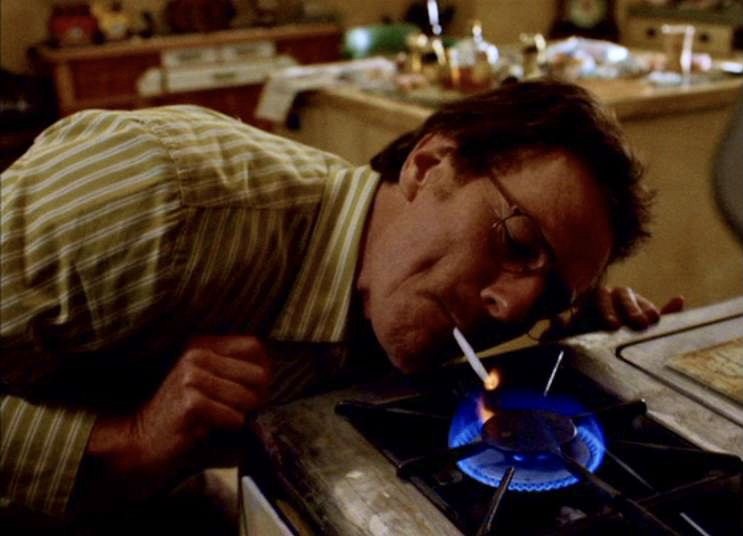
The next day he goes to work, and the next stage comes. His boss tells him to do something in a somewhat rude tone, and instead of Walter dealing with it like usual, he snaps. He starts to yell and rip the products off the wall, which in my opinion he isn’t wrong. Listen y’all, Walter White is seriously going through a midlife crisis, and everyone treats him like he’s worthless. So yes, it’s understandable why he’s a ticking time bomb; honestly, that’s how he feels about his life right now. This is an example of never knowing what someone is going through; therefore, you should always be kind or at least considerate. After Walter storms out, the next scene cuts to him lighting matches and putting them out, illustrating someone’s light can go out so suddenly without a warning. Since Walter is starting to realize his life can end at any moment, he asks Hank (cop brother-in-law) to sit in while they do a drug raid. Hank agrees, and Walter attends; however, when the cops went into the house to scope the scenery, Walter saw something even more fascinating. He sees the other perpetrator leaving the house, but as he looks close enough, he realizes he knows him. Walter was his high school chemistry teacher, so Walter came up with an idea. Walter follows Jessie (Criminal that escaped) and makes him decide on a deal for them to make meth together. Eventually, Jessie agrees because Walter explains to him, he’s a genius in chemistry, and Jessie already knows his way around this line of work. Therefore, they decide that they are a great match.
Now, as the audience, we know this is not Walter’s character, but with so many horrible events, he doesn’t know where to turn. A situation like this can become overwhelming and lead someone down a path they are not prepared for. Although Walter is not thinking about his moralities and boundaries right now; he is worried about paying for his treatments and keeping the financial future of his family secure. That entails a significant amount of funds that cannot be sourced from a high school teacher’s income. Therefore, it makes sense that he makes this deal with Jessie because it could possibly bring in money for chemo and his family. Seeing that Walter is serious as a heart attack, Jessie starts to question him. Asking what’s the real reason he wants to cook meth. Walter looks at him and says, “I am awake”. Meaning he is conscious now, and sees he does not have to be what others portray him to be.So yes, he is making a poor choice, albeit for a noble cause, revealing himself as an anti-villain.
Over time, Walter and Jesse refine their concoction and come to the realization that their meth is unparalleled, thanks to Walter’s exceptional chemistry skills. Consequently, they find themselves entangled in a conflict with two rival drug dealers who are curious about the purity of their product. This curiosity sparks chaos, ultimately driving Walter and Jesse to kill the rivals. Neither of them has ever been in this type of situation, so you can obviously tell that killing them is not something they want to participate in. This leads them to confusion on deciding who will kill them. Clearly, they’re not involved in the drug scene for entertainment or pleasure but out of necessity. Both of them are driven by personal motives to improve their own situations rather than harm others. In the end, Walter is the one that kills them, not because he wanted to but he had to. He tried to negotiate with him, telling him to give reasons on why he shouldn’t kill him. The man ends up yapping about his life story and convinces Walter to let him free. Until Walter goes to retrieve the key and notices a sharp blade missing from a broken plate. Walter walks back downstairs and still attempts to let the man free, before he sees the man reaching for the blade in his pocket. As Walter sees the man trying to kill him, he ends up choking the man from behind trying not to look at him. Not only did he try to fight the sight of the situation, he also repeatedly said I’m sorry while crying. Revealing that this was not a choice he wanted to make, it is evident that he feels remorse for what he has done. This was a great representation of getting yourself into something without knowing where it will get you, even though he is trying to do this for good reasons, it is still a bad deed leading him down a bad path.
Knowing this, we would think Walter goes home and ponders on his actions, but before he could even take a deep breath, he sees his wife crying. For some reason, this inspires him to tell her he has cancer. Although this was a weird take, I did notice something interesting. Walter is wearing a dark green shirt and jacket; if you don’t know, green is a color that can represent stagnation, isolation, and sickness. Which is all what Walter is going through right now. I find it intriguing because this is the first time he has come to reality about his situation, and suddenly the shirt is green. No, that’s no coincidence; the costume designer thought that through. Technically, he has finally understood he is sick, and the green shirt represents that. I mean, everyone has heard you dress how you feel, well, this is that. Walter is sick, and his clothing is even adding to the story. This is a factor I enjoyed seeing because it only gets better, just wait. After Walter tells Skyler about his cancer, the episode ends, and the next begins.
The first scene starts with Walter, Skyler, Walter Jr., Hank, and Skyler’s sister/Hank’s wife, Marie, having a picnic outside their house. They are talking to Walter Jr. about meeting girls, and the conversation leads to Walter explaining how he and Skyler first met. As Walter finishes the story, Skyler begins to cry hysterically and causes a scene. Her sister starts to ask what’s wrong, and Skyler storms out, saying, “Ask him.” Exposing his business to the family without his consent. As the sister repeatedly asks him what’s happening, he finally says he has lung cancer. Dropping this bomb on everyone so improperly, in my opinion, this adds context to why Walter hid his illness. Ultimately, it’s his cancer diagnosis, so he should have the authority to decide whether or when to disclose it. Revealing to loved ones that you have cancer is significant; many opt to keep it private to spare their loved ones’ pain, evade uncomfortable discussions, and sidestep the lifestyle adjustments that accompany the illness. Overall, the scene ends with the family convincing him to go to the best doctor, performing the exact act he was avoiding.
Later, Hank and his fellow police officers discover one of the crime scenes where Walter had been present. Upon searching the premises, they uncover some of the methamphetamine produced by Walter. They bring the meth to the attention of the rest of the police force, who are astonished to find that it is the purest meth they have ever encountered, with a purity of 99.1 percent. They are baffled by its quality and have no leads on who could be responsible for its production. As Hank is explaining the seriousness of the circumstance, he says, “We got new players in town Now, we don’t know who they are, or where they come from… … but they possess an extremely high skill set. …I’m thinking Albuquerque just might have a new kingpin.” Even though Hank’s depiction of the producer portrays him as a menacing drug dealer, the scene depicts Walter in the bathroom brushing his teeth while undressed, appearing weary. Portraying someone who doesn’t fit the typical image can be truly surprising. It underscores the notion that one never truly knows what someone is capable of. While Walter is also in the bathroom, he begins to cough loudly, prompting his wife to knock on the door and offer assistance. Walter reassures her that he is fine and simply desires privacy, declining her help. This reaction is understandable; accepting assistance can evoke feelings of vulnerability and clash with one’s sense of independence. One of the reasons he concealed his illness is because nobody wants to feel powerless due to cancer. It’s dehumanizing to have your entire life disrupted by something so sudden, forcing drastic changes in everyday life.
While we haven’t explored Jesse’s character extensively, integrating this aspect helps to clarify the show’s dynamics. This episode delves into his past, depicting him getting high on his supply and becoming extremely anxious, leading him to flee to his parents’ backyard. Though his parents don’t appear overly pleased to see him, they still invite him inside their suburban home. The contrast between their pleasant household and Jesse’s struggles is evident, especially with the presence of their other son. The two are complete opposites, while Jessie is a drug dealer, the other son participates in many educated and useful activities. Such as soccer, the oboe, piano, and more. As Jessie gets comfortable, he starts to converse with his brother; their mother comes to check on them and ask if they’re okay. Jessie responds with a yes, but she doesn’t leave the room until his brother says yes as well. This triggers Jesse, prompting him to exclaim, “Am I some sort of criminal or what?” as he mockingly imitates his mother, “‘Oh, we can’t let that scumbag corrupt the mind of our favorite son!.” This revelation exposes his sense of betrayal upon witnessing his brother receiving all the attention, guidance, and care he had longed for. Yet, just when we assume Jesse is the despised son, his younger brother retorts, “I’m the favorite, you’re practically all they talk about.” This unveils the poignant truth: the parents’ motivation behind pushing activities onto the other son was to prevent him from becoming like Jesse. I mean, if all they do is discuss Jesse, it’s evident they harbor regrets about their parenting approach and are now striving to change. It’s a common occurrence in real life, and this show effectively captures the realism of family dynamics.
Shortly after, Jesse found himself kicked out, prompting him to search for a job and strive for self-improvement. However, the job he landed wasn’t what he anticipated. Dressed sharply for the interview, Jesse tried to persuade the manager of his potential value to their sales team. Yet, without hesitation, the manager clarified that there had been a misunderstanding: it wasn’t a sales job interview, but rather a position as an advertiser, donning a money suit and flipping a sign. Hearing this revelation, Jesse’s demeanor instantly shifted to one of regret as he lowered his head and departed. This incident reveals Jesse’s reluctance to settle for a mediocre job; he desires financial success and refuses to accept anything less. It elucidates why he turned to the drug business; he lacks patience and prefers to maintain stability on his own terms. Unfortunately, this reflects a common sentiment among many young adults who feel they shouldn’t have to compromise their passions for financial security. Though as Jesse leaves the interview the next scene begins.
The scene consists of Skyler and Walter going to an old friend’s party. As they are driving there, Walter is complaining about how stupid his gift is. He starts to overthink and says he won’t give the gift at all because the invitation said no gifts anyway. Skyler convinces him to keep the gift, and they arrive at the party, where you see a table full of gifts, making Walter more nervous about the situation. Walter sees his old friend, and it seems like no time has passed; they are nice and friendly as if they never stopped talking. The scene goes on, and it shows Walter’s old friend Elliot opening all of his gifts; you see they are expensive and meaningful gifts. Such as guitars, TVs, and much more; then it comes down to Walter’s gift. As Elliot opens the gift, we see that it is a pack of young good ramen. Now this may seem like a meaningless gift, but in reality, it’s not. Elliot goes on a whole rant about how they lived on this ramen for ten months straight while they were in college. He says he believes this ramen helped their success; overall, he said he loved his gift and was thankful for it. It shows that maybe expensive gifts aren’t the best, but meaningful gifts that matter are. Right? Wrong. The two go on to have a personal conversation. While they are enjoying reflecting on old memories, Elliot offers a random job offer to his highly successful company. Walter pauses and says the offer is appealing but he has personal issues. Before he could even finish his sentence Elliot says, “We have excellent health insurance.” Revealing his wife went and told about his cancer AGAIN. Just leaving Walter’s opinion and privacy astray, this is pure disrespect. As Walter thought his friend was just being nice, it turned out it was all for pity. Imagine that, thinking you and an old friend rekindled again like time never passed, but instead, it was because he felt bad for you. No, that’s wrong; literally one of the reasons people hide their illness. This show distinctly demonstrates how not to treat someone who is sick. Just because they’re unwell doesn’t mean they don’t want to engage in everyday activities and normalities. The scene ends with Walter declining the job and leaving madly, telling his wife to stop spewing his personal business.
Seeing that her strategy to persuade Walter to agree to treatment isn’t effective, Skyler opts to organize a family intervention for him. Skyler, Marie, Hank, and Walter Jr. all attend. You can see Walter is unhappy and not prepared for what’s next. The family goes in a circle telling Walter how they feel about the disease HE IS DIAGNOSED WITH. Hank starts with an unconvincing speech, probably making Walter want to die even more. He makes sports and card game references instead of talking to him appropriately about the subject, somewhat showing he’s not even taken the situation seriously. Even his wife asks, “What the hell are you saying?” but before he could respond Skyler says, “No, let him keep going, this is what we are here for,” appearing that she only cares about convincing Walter to get on chemo. After seeing Hank wasn’t convincing, she makes Walter Jr. speak his mind. He starts off with calling his dad a pussy because he feels that he went through struggles as well with his cerebral palsy. He doesn’t understand why his dad didn’t give up on him but wants to give up on himself. Now listen, that’s understandable to feel like that as his son, but that doesn’t mean invalidate Walter feelings. He is the one suffering from the disease, and although Walter Jr. also struggles with his disability it is not the equivalent. Eventually, Marie sees what’s happening is wrong, and says, “I think you should do whatever you want to do, you’re the one with cancer.” This sets Skyler off, leading her to tell Marie she is wrong for saying her opinion. Yet, Skyler met her match Marie does not care to change her mind. Instead, she states that she is the medical professional that x-rays cancer patients every day, seeing how miserable they are because their family convinced them to get treatment. Unveiling the sorrowful truth that sometimes the treatment can make the patient feel worse than they were before. As Skyler hears Marie go on she starts a huge argument that has to get calmed down by Walter whistling. When the family gets quiet Walter starts to tell his side of his story. He feels that his whole life he never had his own say, but now with this last choice of cancer, he wants to finally take control. Skyler interrupts and says, “Well pick the right choice.” “Don’t you want to see your son and daughter grow up?” Without a pause Walter says, of course I do, but at what good is it. Every day he would have to live in pain and agony; not being able to work, enjoy a meal, move his head because of the nausea, and more. Essentially describing a man who feels he has no value and does not want to be remembered as such. With this speech, I fully understood Walter’s point of view; That’s not living, that’s surviving, in fact, that’s artificial life.
As effective as this scene was in raising awareness about the patient’s perspective, it also had another notable aspect. While the intervention focused on Walter’s cancer diagnosis, the designers managed to deliver another impactful element. If you take a look at everyone’s shirt, they are all different colors except Skyler and Walter Jr. Though why does that matter isn’t that normal? Yes, it is, but in the realm of TV everything should tell a story. Therefore let’s start with Walter, in this scene his shirt is a darker green than it was before. Telling the audience Walter is getting sicker as time goes by. Then onto Hank his shirt is yellow, which some of the negative connotations of yellow are egotism, deception, and betrayal. As of now I haven’t seen any true betrayal but everything else is spot on, in every scene Hank tries to act better than Walter or deceives him as a person. Therefore you can’t tell me that’s a coincidence, somehow they found a shirt that describes his personality. As I said in other movie reviews, “I think not.” Going on to Marie, her shirt is purple which represents wisdom, consideration, and encouragement. Truly every factor Marie has displayed for us in this scene. Lastly comes Skyler and Walter Jr. both in blue. Blue meaning trustful, fragile, and depressive; now are you going to sit here and tell me that does not paint the picture of them both? No. No you will not. These colors all correlated with each character and related heavily to the conversation being held in this scene. With that being said the storytelling became 10x better.
The scene concludes, and the following day, Walter informs Skyler that he will undergo treatment. They go seek medical treatment, and Walter gets his first round of chemo. Right after the procedure, Walter meets up with Jesse and asks, “Wanna cook?” Disclosing he truly only does this for money and personal gain, he needs the funds to keep his family stable due to his illness. Showing the audience this is genuinely for his family’s good. Going back to what he said in the first episode, “I just want you to know no matter how it may look, I only had you in my heart.” Anyways, the two start cooking again, but in the midst of it, Walter storms out coughing and unbuttoning his shirt for air. Jesse steps outside to check on Walter and quickly realizes that Walter has cancer. Walter is puzzled as to how Jesse knew, but Jesse explains that he noticed the red dot used for radiation targeting, as his aunt used to have them. It’s evident that Jesse is affected by this news, indicating that their relationship has evolved beyond just a partnership—he has begun to care for Walter. Despite this, they manage to finish producing the pound of methamphetamine, but only sell an ounce. This infuriates Walter, who believes the process should be faster, prompting him to ask Jesse why they don’t just sell the entire pound at once. Jesse explains to him that finding someone who can afford it is a difficult task. Walter basically tells him he doesn’t care and he needs to find someone.
Later on, we see Hank getting some more evidence from the crime scene Walter was involved with. Hank notices the gas mask that was used to cook meth was stolen from the school Walter teaches at. Consequently, Hank shows up at the school and asks Walter to do a walk through the inventory. Trying not to raise any suspicion, Walter calmly agrees. As they walk through together, Hank asks who keeps the keys to the inventory room. Walter stays honest and tells him he does, the principal, faculty, and staff. Hank goes onto the next question asking do the kids know where you guys place the keys. Walter responds with a, “No, I wouldn’t think so,” and Hank says, “Look, Walt, I know they’re your students, but don’t underestimate them big mistake.” Little does he know the culprit is right under his nose. He is so clueless he makes a joke to Walter saying, “We don’t want people start wondering about you right.” Although the joke sounds intimidating, you could see Hank would never guess Walter is the one behind this 99.1 percent methamphetamine. They perceive him solely as a coward, viewing him as merely an educator with brains, not recognizing his potential as a criminal mastermind. With this, the scene comes to an end and on to the next.
It goes to Jesse finding a vendor for their drugs, someone to buy the whole pound and sell it themselves. He finds a man named Tuco, who seems legit. When he takes the meth to him, the first thing Tuco does is try it, his reaction was ecstatic, it was as if it was the best drugs he’s ever had. He asked who made it, and Jesse said him and his partner. Tuco doesn’t believe him at first but with some convincing he is sold. Tuco says they have a deal, but Jesse hasn’t even said how much yet. When Tuco asked how much, Jesse said, “35,000 for the pound,” leading Tuco to say, “Sure, deal. Get out of here,” without giving Jesse the money. This didn’t sit well with Jesse, so he tries to take the drugs back and run. This makes Tuco very angry; in fact, he puts 35,000 in a bag and beats Jesse with it. Tuco beats him so badly he ends up in the hospital with busted ribs, a concussion, and more. When Walter finds this out he gets all of Tuco’s information seeking revenge for his partner. Backtracking to the fact that this is not only a partnership anymore, they care for each other and wouldn’t let one go down without putting up a fight. This will be proven shortly.
The next day when Walter finds all of Tuco’s information, he goes to his lair. When he arrives, he tells Tuco he wants 50,000 dollars. This cracks Tuco up and makes him ask why he feels that way. Walter says it’s for the pound of meth he stole and his partner’s pain and suffering. As predicted, this cracks Tuco up even more, leading him to say, “Let me get this straight. I steal your dope, I beat the piss out of your mule boy, and you walk in here and bring me more meth. Woah, that’s a brilliant plan.” Without his knowledge, Walter has a better plan up his sleeve. Walter remarks, “And you got one part of that wrong; this is not meth,” as he swiftly discards it to the ground, unveiling it to be fulminate of mercury, a potent explosive. The sudden revelation triggers an explosion, engulfing the top half of Tuco’s lair in flames. With this surprise, Tuco is left to do nothing else but give him his money and make a deal. Upon receiving the money, Walter heads to the car and jubilantly celebrates. Observing closely, I notice a change in his clothing and appearance. He now dons black attire, symbolizing power, protection, and dominance—traits that align with Walter’s newfound gains. In the beginning, he was only in sickly and depressing colors, such as yellow and green. This is a clear representation of his development and growth with self-confidence. Although now in episode 6, the one before the season finale, he is now in black.
Leading up to episode 7, we see Walter and Jesse meeting up with Tuco. When Tuco arrives, the three make the drug deal, and everything goes fine. They even made another agreement to meet next week to buy 4 pounds. When the meet comes it goes smooth just as the last. Until Tuco’s friend says one remark that sets Tuco off, which was, “Remember who you’re working for.” Walter didn’t react at all, yet Tuco did. He starts to tweak out saying, “Like they don’t already know that.” Basically threatening Tuco’s authority. When Tuco became offended by this slight comment, he started to beat the man worse than he did Jesse. During the fight, Walter tries to help, but Tuco’s other buddy stops him. Showing this is a normal thing, due to there being no reaction on the other friend’s face. When the fight is over, Walter and Jesse are left with their jaws to the floor, while Tuco leaves relieved as if nothing happened. Ultimately being the end of the season finale.
In my opinion, I loved the ending. It showed what Walter has gotten himself into and who he is dealing with. Proving if Walter and Jesse did want to get out of the business it wouldn’t be easy. Think about it, if Tuco did that to one of his homies imagine what he would do to someone he just met. On top of that, he loves their product. Not only because of the sales, but because he uses them. So imagine what he would do for this product himself as an addict. Overall, this was a great ending because it gives a sneak peek of what Walter is in for during the next season.
Well, that was Breaking Bad, guys. A show that I had no hope in before watching, but after viewing, I see what the hype is about. Down to the foreshadowing in the first episode, color theory work, relatability, and more. In conclusion, delving into the intricate layers of “Breaking Bad” reveals a narrative masterpiece that transcends the boundaries of conventional television. Through its compelling characters, morally ambiguous themes, and meticulous attention to detail, the series captivates audiences with its exploration of human nature and the consequences of choice. From Walter White’s transformation from a mild-mannered chemistry teacher to a ruthless drug lord, to the complex dynamics of his relationships with Jesse Pinkman and other characters, “Breaking Bad” offers a profound reflection on the fragility of morality and the allure of power. As viewers journey through the highs and lows of Walter’s descent into darkness, they are confronted with thought-provoking questions about identity, ambition, and the nature of good and evil. Ultimately, “Breaking Bad” stands as a testament to the power of storytelling, leaving a lasting impact on its audience and solidifying its place as one of the greatest television series of all time. Yet, I still have to rate it. Giving it a fair and square 4. You might think, “Precious, why not a 5?” Well, as good as the first season is, it still lacks some factors listed on my rubric. Such as adding music components to help tell the story, followed rules of thirds fluently, made me cry, and about 2 more. Don’t get me wrong I love Breaking Bad, but I must stay truthful with my ratings.
 The Precious Evaluation